Patina AI · Watch Health
Hear how the movement is running.
Patina AI uses the phone microphone to capture a mechanical watch’s beat and present rate, amplitude, beat error, and measurement history in plain language you can carry into an ownership or service conversation.
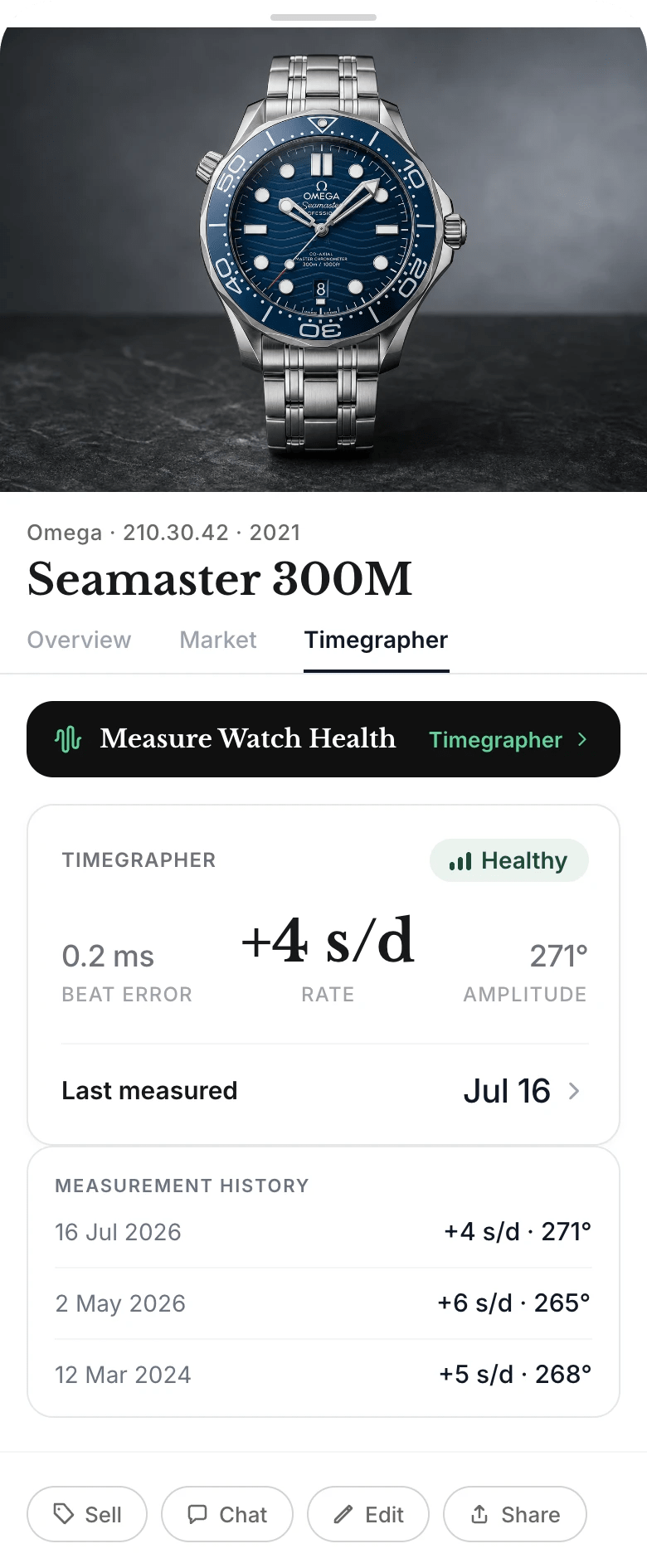
Create a repeatable listening condition.
Place the watch in a quiet setting, position the phone as directed, and let the microphone listen for a stable beat. A clean capture matters because background sound, movement, placement, and a weak signal can all affect what the software is able to interpret.
- Reduce background noise before recording
- Keep the watch and phone steady during capture
- Repeat a noisy or unstable measurement
Understand rate, amplitude, and beat error plainly.
Rate describes how quickly the movement appears to gain or lose time over a day. Amplitude reflects the balance wheel’s swing under the measured conditions, while beat error describes timing symmetry between alternating beats. Each signal adds context; none tells the whole service story alone.
- Rate: estimated daily gain or loss
- Amplitude: the measured balance-wheel swing
- Beat error: timing difference between alternating beats
Compare readings instead of overreacting to one capture.
Measurement history helps you revisit readings taken at different times and notice a change worth investigating. Keep position, wind state, environment, and capture quality in mind when comparing them; a difference may reflect conditions as well as movement behavior.
Use the reading to inform a service conversation.
Patina AI provides educational context from an acoustic measurement, not a professional service diagnosis. It cannot inspect lubrication, wear, water resistance, internal damage, or every factor that affects performance, so persistent concerns belong with a qualified watchmaker.
Watch Health, in practice.
The product supports your judgment with connected records and context. Open any question for the practical answer.
What does the Timegrapher measure?
It listens to the movement’s beat and estimates rate, amplitude, and beat error under the capture conditions. Those values describe aspects of timing behavior, not the movement’s complete mechanical condition.
Why might two readings differ?
Watch position, wind state, temperature, background noise, phone placement, and capture stability can all influence a reading. Use consistent conditions when you want a more useful comparison.
Can a Timegrapher reading replace a watchmaker?
No. It is not a professional service diagnosis and cannot inspect the movement internally. Use it as context, then consult a qualified watchmaker for persistent concerns or purchase-critical inspection.
The next watch starts here
Keep the next watch decision connected.
Bring Patina AI to the watch in front of you, then carry the context into the next step of the workflow.